In the previous blog post, we took a look at how we approach teaching the history of the Islamic world within our integrated Islamic studies curriculum. In this blog post, we’ll look at how and why our curriculum covers the history of the Western world.
“Western civilization”
In the United States, most public schools teach history by focusing primarily on what is often called the history of “Western civilization” or the “Western world” (understood as roughly referring to Europe and North America). Private Islamic schools in the U.S. often adopt the same textbooks used in public schools, and therefore end up teaching history in much the same way as secular public schools.
We believe that Muslim students growing up in the United States should be informed about the histories of both the Islamic and Western worlds. In particular, an understanding of European and American history is essential for living an informed life in the U.S. Moreover, we anticipate that some of our students may trace part of their ancestry to Europe and/or the Americas. Just as a student of Lebanese or Indian ancestry should feel “seen” in their study of history, so should a student of Irish or German ancestry. To that end, our curriculum is being designed to emphasize not one, but two long-running historical narratives: that of the Islamic world, and that of the Western world.
How should we cover the history of the Western world?
Since coverage of the history of the Western world is already standard throughout the United States, one might ask why we are writing our own material for teaching this history, rather than adopting a curriculum that already exists. Unfortunately, many existing curricula present a view of Western history that privileges Europe and the United States above the rest of the world and celebrates various modern developments as an idealized end goal that the rest of the world must catch up to. Moreover, these curricula frequently minimize some of the darker aspects of Western history, such as the history of colonization. While no curriculum is free from bias, many existing curricula suffer in terms of historical credibility and do not integrate well with an Islamic framework for understanding the world.
Fortunately, historians and curriculum designers of various backgrounds have developed some newer (and likely less-widely adopted) history curricula that take a more balanced approach. These curricula cover Western history with greater nuance, but it is our position that our integrated curriculum is best served by writing our own material on western history. First, this will allow us to better emphasize the many connections between the histories of the Western and Islamic worlds. Second, our internally-produced curriculum will also help our students learn to examine history from a moral perspective informed by the Qur’an and the teachings of Prophet Muhammad and his household, peace be upon them all.
Are the histories of the Western and Islamic worlds really separate stories?
We are crafting our curriculum so as to present the histories of the Islamic and Western worlds as two intimately linked story arcs. These two story arcs intersect at points that reveal economic interdependence, the exchange of ideas, and also conflict. Indeed, Muslims and “Westerners” alike saw (and continue to see) themselves as inheritors of the intellectual legacy of the Mesopotamian, Greek, and Roman civilizations. Muslims (and non-Muslims living in the Islamic world) did not merely translate Greek and Roman texts, but they also contributed intellectually to a preexisting body of knowledge that would influence later Western thinkers. Moreover, figures such as the Prophets Abraham, Moses, and Jesus (Ibrahim, Musa, and Isa), peace be upon them are revered and seen as moral examples for Muslims, just as they are for many living in the West.
Meanwhile, we also want to present an honest and nuanced history where we gradually introduce students in higher grades to some of the darker intersection points of these two historical arcs. These include introducing students (in an age appropriate manner) to occasional periods of intense conflict between those living in “the Islamic world” and those living in “the West,” as well as presenting how colonialism and Western modernity came to transform the Islamic world in the last several centuries.
What about America?
Throughout this blog post, we’ve referenced Western history more generally. In the next blog post, we’ll look at our approach to teaching American history within our integrated Islamic studies curriculum.
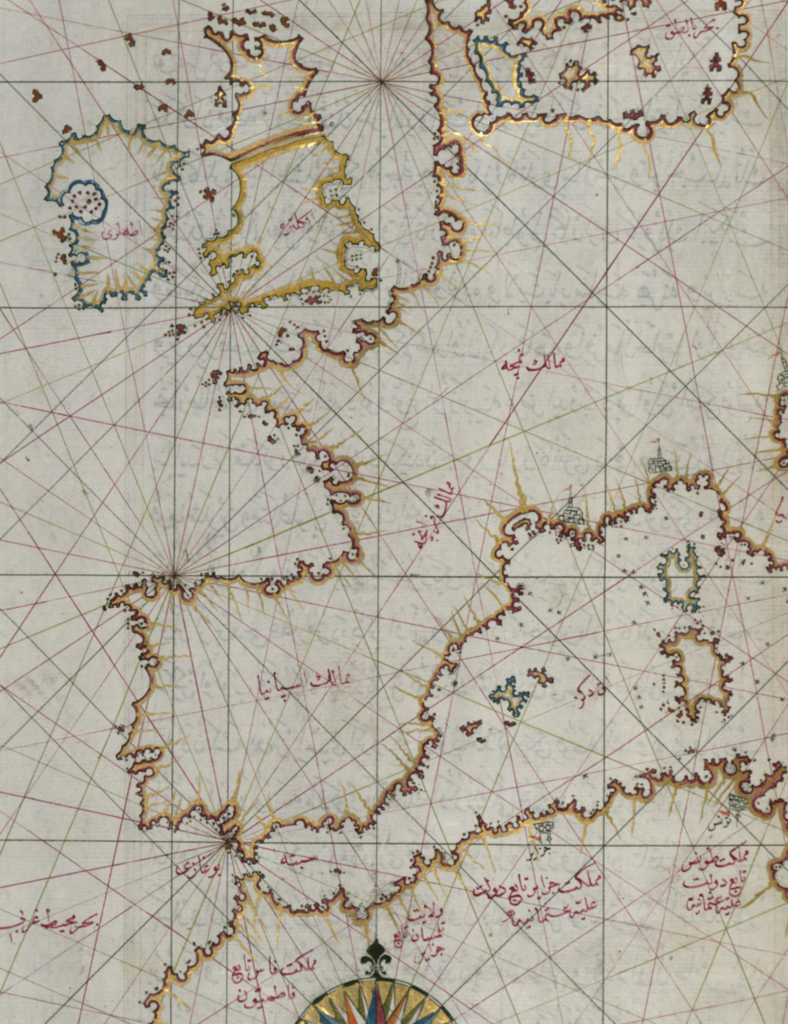
Image: Map of Western Europe and Northwest Africa from the Ottoman Cartographer Piri Reis (died c. 1553) from the Walters Art Museum in Baltimore, Maryland.